

|
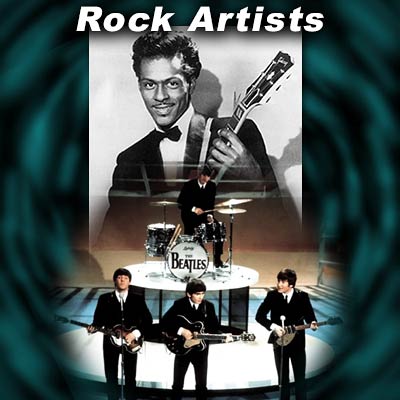
1. The Beatles
2. Elvis Presley 3. James Brown 4. Bob Dylan 5. The Rolling Stones 6. Stevie Wonder 7. Chuck Berry 8. The Who 9. Led Zeppelin 10. Ray Charles 11. The Beach Boys 12. Aretha Franklin 13. Fats Domino 14. Michael Jackson 15. Madonna 16. Jimi Hendrix 17. Little Richard 18. Bruce Springsteen 19. Marvin Gaye 20. Sam Cooke 21. Prince 22. U2 23. The Supremes 24. Pink Floyd 25. Elton John 26. Run-D.M.C. 27. Queen 28. Nirvana 29. The Temptations 30. The Everly Brothers 31. David Bowie 32. Buddy Holly & The Crickets 33. Neil Young 34. Bob Marley & the Wailers 35. Public Enemy 36. Sly & The Family Stone 37. Bill Haley & His Comets 38. Smokey Robinson & The Miracles 39. The Kinks 40. R.E.M. 41. Bo Diddley 42. Black Sabbath 43. The Doors 44. Jay-Z 45. The Clash 46. Otis Redding 47. The Grateful Dead 48. The Byrds 49. Van Halen 50. The Drifters 51. 2pac 52. Eminem 53. The Beastie Boys 54. Roy Orbison 55. George Clinton & Parliament / Funkadelic 56. Metallica 57. Simon & Garfunkel 58. The Impressions 59. Jerry Lee Lewis 60. Eagles 61. Joni Mitchell 62. Fleetwood Mac 63. Creedence Clearwater Revival 64. Aerosmith 65. Pearl Jam 66. The Bee Gees 67. The Platters 68. The Clovers 69. Janet Jackson 70. Jackie Wilson 71. Ruth Brown 72. Donna Summer 73. Van Morrison 74. Cream 75. The Isley Brothers 76. The Police 77. Al Green 78. AC/DC 79. Deep Purple 80. Radiohead 81. Mariah Carey 82. Outkast 83. Rod Stewart 84. The Four Seasons 85. The Shirelles 86. The Dominoes 87. Kanye West 88. Elvis Costello 89. Crosby, Stills, & Nash (& Young) 90. Big Joe Turner 91. Johnny Otis 92. Whitney Houston 93. Guns N' Roses 94. N.W.A 95. The Allman Brothers Band 96. Billy Joel 97. Janis Joplin 98. The Band 99. Sonny Til & the Orioles 100. Paul McCartney / Wings |
|
|
Criteria In Detail:
Popularity: Charted singles and albums (with some consideration as to the era in which they took place to establish context - albums were not big in the 50's and early 60's for rock artists and most put no effort into them, black rock artists mostly did not pay full attention to them until the early 70's; certain styles received little radio airplay which negatively affect single success, such as metal and early rap; pre-1955 rock also was made for and appealed to a racially segregated market, so the R&B Charts are more accurate as to what was popular within the rock community at the time, but that has to be balanced to reflect that post-1955 rock on the pop charts was not only competing with other rock, but also all of pop music as a whole). It also includes sales figures and headlining appearances and so forth but these are considered secondarily. However, as with chart success, era and style specific context is factored in. In terms of concerts not all artistic styles are created equal. A vocal harmony group, no matter how popular, won't fill stadiums because their music doesn't translate well to the venue. Rap is harder to duplicate live. It is based on roughly a 80/20 split for US/UK. In cases where an artist undeniably has a very high level of worldwide popularity, that can be used as a tiebreaker. Influence: Primary Influence, which is worth more, is for true innovation, the starting point of a new style or method of singing, songwriting, playing, performance, production, stage shows, arranging, etc., which consequently goes on to become widespread at some point in the future. The origins of the innovation are what matters most here, not necessarily who others credit with exposing them to it and so it is necessary to trace back all things to their origins as best as possible. Secondary Influence is for those who did NOT innovate, but whose application in their own work of an earlier innovation served to popularize it to a far greater extent. Because this is not the creative aspect of it, secondary influence, which is far more common to see and can be divided up between multiple artists over the years, is not worth as much. Musical Impact: The reaction within the music industry as a whole to an artist's work. This differs from influence because not all artists are even able to be influenced by things they admire. Different styles, different abilities, different audiences and different musical goals and a sense of creative independence means that artists many times would prefer to follow their own path, but their appreciation for another artist's achievements elevates the stature of that artist in the industry. This attempts to accurately determine what music was turning the most heads within their own community at the time, what was seen as raising the creative bar and set new benchmarks to strive to surpass. It is the peer recognition factor of the criteria. Cultural Impact: The myriad of ways in which artists affect the mass popular culture, as over the years music has altered virtually everything around us in one way or another at times - racially, sexually, in language, fashion and slang. It's changed the dominant marketplace for music as a whole from adults to teenagers, it's changed the way the music industry itself operated, created untold controversy and started national and international dialogue on a wide variety of topics that have frequently changed the viewpoints of generations to follow. It is not always intentional, but when it happens the societal parameters often shift in some ways. Basically, how far an artist's career penetrated into society. This is the hardest to get, simply because it is difficult to affect such change, but it something that often separates the elite from the merely great and is ultimately a major part of the lasting legacy of rock music as a whole. Essentially the goal in this criteria was to, as objectively as possible and by removing musical taste entirely, determine which artists made the most impact in their field. It doesn't require an artist to take on a specific role that is optional to do in order to BE an artist. In other words, there's no separate category for things such as writing, playing a specific instrument, producing, or performing live. Yet those all can and do factor in more objectively in the existing criteria. An innovative guitarist gets influence points for introducing new techniques, an artist's songwriting sees his or her Musical Impact level raised as a result, an artist taking the reins of production changes the business models within rock and therefore has Cultural Impact within the industry. | |
| ||||||||||||
| ||||||||||||